
International Airport Layover Rules and Transit Visa Requirements: A Complete Guide for Travellers
When planning an international trip, most travellers focus on flight tickets, accommodation and destination visas. However, one important detail often gets overlooked: international airport layover rules and transit visa requirements.
If your flight includes a stop in another country before reaching your final destination, you may need to follow specific immigration procedures or obtain a transit visa. Even if you are not planning to leave the airport, certain countries require passengers to have permission to transit through their airports.
For travellers from Kerala planning international holidays, understanding these requirements before booking flight tickets can help avoid unexpected immigration issues, missed connections and last-minute travel complications.
This guide explains international airport layover rules, different types of transit visas, the difference between an airport transit visa and a tourist visa, and the important things to check before booking a connecting flight.
1. What Is an International Airport Layover?
An international airport layover is a scheduled stop at an airport between your departure city and final destination. It happens when your journey involves two or more connecting flights instead of a direct flight.
For example, if you are travelling from Kochi to London with a connecting flight in Dubai, Dubai becomes your transit point.
During this stop, you may need to remain inside the international transit area or pass through immigration, depending on your flight arrangement and the airport's regulations.
Common types of airport layovers include:
Short layover: A connection lasting a few hours, usually without leaving the airport.
Long layover: A longer waiting period between connecting flights, which may provide time to explore airport facilities.
Overnight layover: A connection requiring passengers to wait overnight before boarding their next flight.
Self-transfer layover: A connection where passengers may need to collect their baggage, check in again and pass through immigration independently.
Understanding your layover type is important because visa requirements can change depending on how you connect to your next flight.
2. International Airport Layover Rules and Transit Visa Requirements
Airport transit rules are different from country to country. Some destinations allow eligible international passengers to remain inside the airport without obtaining a separate visa, while others require an airport transit visa even if the passenger does not leave the international transit area.
Before booking a connecting flight, check the following rules.
Staying Inside the International Transit Area
Some airports have designated international transit zones where passengers can wait for their connecting flights without formally entering the country.
However, access to these areas depends on airport facilities, immigration regulations and your nationality.
You may need a transit visa even when you do not intend to leave the airport.
Changing Terminals During a Layover
Not every terminal transfer is the same. Some airports allow passengers to move between terminals without passing through immigration, while others require travellers to enter the country before accessing another terminal.
Always confirm whether your connecting flight requires an airside or landside transfer.
Collecting and Rechecking Baggage
If your baggage is checked through to your final destination, you may not need to collect it during your layover.
However, passengers travelling on separate tickets or self-transfer bookings may need to collect their luggage and check in again.
This can require passing through immigration, which may mean you need an appropriate entry visa.
Separate Flight Tickets and Self-Transfers
Booking two separate flight tickets can sometimes reduce travel costs, but it also creates additional responsibilities.
You may need to:
Collect your checked baggage.
Pass through immigration.
Complete a new airline check-in.
Clear security again.
Meet the next airline's check-in deadline.
Do not assume that a connecting flight automatically allows you to remain in the international transit area.
Overnight Airport Layovers
Some airports provide transit hotels or sleeping facilities inside their international terminals. Others require passengers to enter the country to access accommodation outside the airport.
Check whether your transit visa permits you to leave the international area before booking an overnight stay.
Do Transit Visa Requirements Depend on Your Nationality?
Yes. Transit visa requirements are often determined by your passport nationality, destination, transit country and travel arrangements.
For example, an Indian passport holder travelling from Kochi to Canada through the UK may face different transit requirements from
someone travelling through Dubai or Singapore.
Some countries also provide exemptions for passengers holding valid visas or residence permits from specific countries.
Therefore, never assume that a transit visa is unnecessary simply because you are not leaving the airport.
Still Confused About Transit Visa Requirements?
Not sure whether your connecting flight requires a transit visa? Club Travalet offers visa assistance and travel guidance to help you understand the requirements before your journey.
Get expert guidance and enjoy 24/7 human travel support whenever you need assistance.
📞 Speak to a Travel Expert | Call Now
💬 Get Instant Help | WhatsApp Now
3. Airport Transit Visa vs Tourist Visa: Key Differences Explained
An airport transit visa and a tourist visa serve two different purposes. Although both are travel documents issued by a foreign country, their permitted activities, duration and entry conditions are different.
Understanding this difference is especially important when planning international connecting flights.
What Is an Airport Transit Visa?
An airport transit visa is a short-term travel authorisation that allows eligible passengers to pass through the international transit area of an airport while travelling to another country.
It is generally intended for travellers who need to change flights without entering the country.
For example, an Indian traveller flying from Kochi to Germany through an airport in a country that requires an airport transit visa may need to obtain this document before departure.
An airport transit visa usually does not permit you to:
Leave the international transit area.
Visit tourist attractions outside the airport.
Stay in hotels outside the airport without appropriate entry permission.
Use the transit visa as a substitute for a tourist visa.
The exact conditions depend on the issuing country's immigration rules.
What Is a Tourist Visa?
A tourist visa allows eligible foreign nationals to enter a country for permitted leisure and tourism activities.
Unlike an airport transit visa, a tourist visa generally allows travellers to pass through immigration and explore the destination during their authorised stay.
Depending on the visa conditions, travellers may be able to:
Visit tourist attractions and popular destinations.
Stay in hotels and other permitted accommodation.
Meet friends and family.
Participate in permitted leisure activities.
Travel within the country during the authorised period.
A tourist visa does not automatically provide permission to work, study or undertake other restricted activities.
Airport Transit Visa vs Tourist Visa: Key Differences
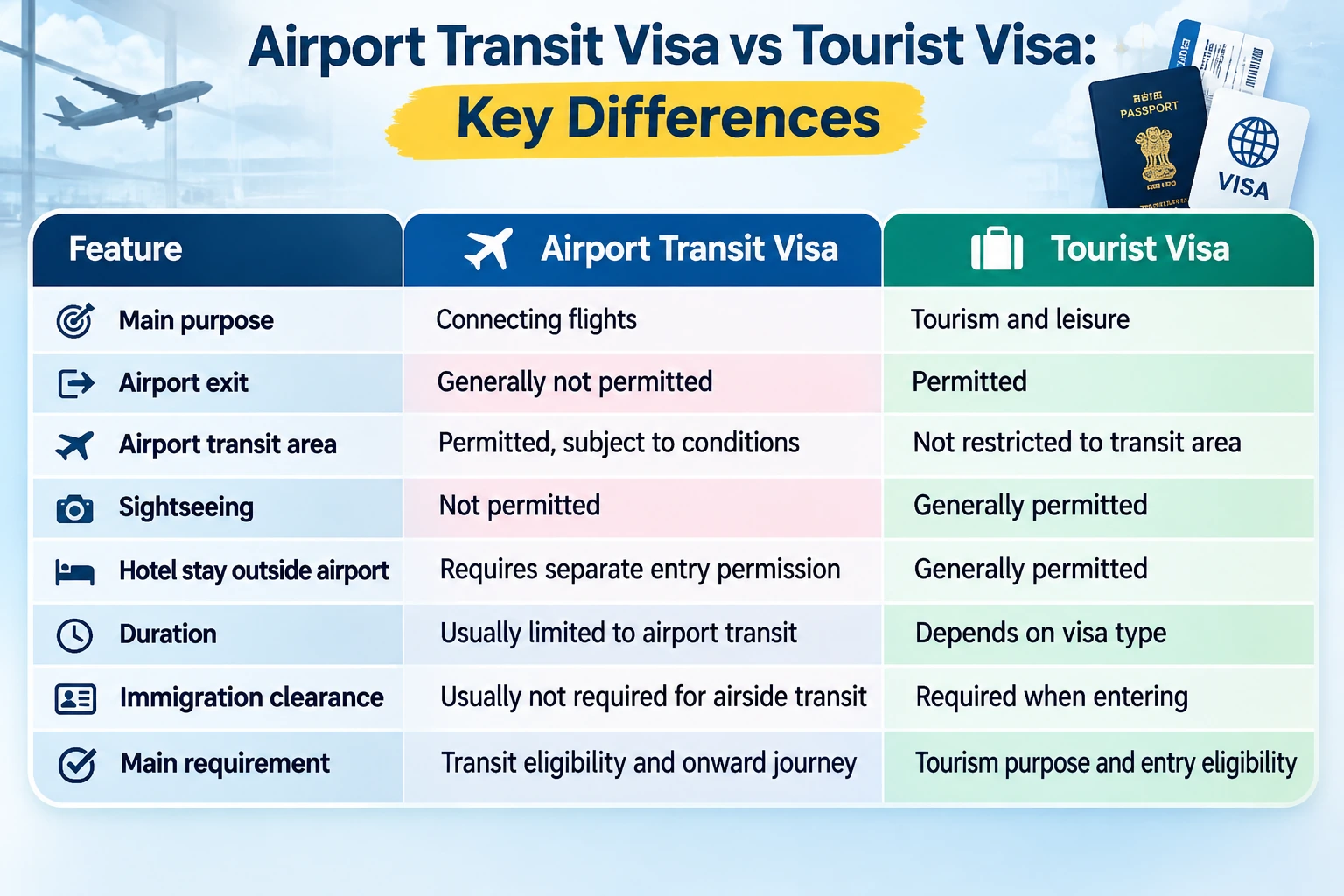
Important: Some countries offer different transit visa categories. For example, a transit visitor visa may allow passengers to enter a country briefly, while an airport transit visa only permits them to remain in the international transit area.
Can a Tourist Visa Be Used Instead of a Transit Visa?
In some countries, a valid tourist or visitor visa can exempt a traveller from obtaining a separate transit visa.
For example, UK government guidance lists a valid Standard Visitor visa among the documents that can remove the need for a separate UK transit visa.
However, this depends on the country's specific immigration rules and the type of visa you hold.
Always verify the applicable exemptions before travelling.
4. Different Types of Transit Visas for International Travellers
Transit visas are not identical across all countries. Depending on your journey, you may come across different categories.
Airport Transit Visa (ATV)
An Airport Transit Visa allows eligible passengers to remain in an airport's international transit area while waiting for their connecting flight.
It generally does not permit entry into the country.
Transit Visa
A regular transit visa may allow travellers to enter a country for a short period while continuing their journey to another destination.
This may be necessary when passengers need to pass through immigration, collect baggage or stay outside the airport.
Direct Airside Transit Visa
A Direct Airside Transit Visa is a specific category used by the United Kingdom. It applies to certain travellers changing flights without passing through UK border control.
Visitor in Transit Visa
The UK also offers a Visitor in Transit Visa for certain travellers who need to pass through UK border control and leave the country within 48 hours.
These categories demonstrate why travellers should check the exact visa terminology used by their transit country rather than assuming that all transit visas offer the same permissions.
5. Transit Visa Rules in Popular International Transit Countries
Several international airports serve as major connecting points for travellers from India. Here are some important examples.
Dubai, United Arab Emirates
Dubai is a popular transit destination for travellers flying from Kerala to Europe, the Americas and other international destinations.
The UAE provides 48-hour and 96-hour transit visa options for eligible passengers who want to enter the country during their stopover.
These visas are arranged through UAE-based airlines and must be approved before entering the UAE. Travellers who remain airside may not need a transit visa, depending on their nationality and circumstances.
Official information: UAE Government Transit Visa Guidelines.
London, United Kingdom
The UK distinguishes between airside and landside transit.
Airside transit: You change flights without passing through UK border control.
Landside transit: You pass through UK border control before continuing your journey.
Depending on your nationality, destination documents and travel arrangements, you may need a Direct Airside Transit Visa or Visitor in Transit Visa.
Official information: UK Airport Transit Visa Guidelines.
Singapore
Singapore is another major connecting point for travellers from India.
Whether you need permission to enter Singapore or can remain in transit depends on your nationality, travel documents and itinerary.
Some eligible Indian travellers may use the 96-hour Visa-Free Transit Facility (VFTF), subject to specific conditions. These include holding a valid visa or long-term pass from certain eligible countries and having a confirmed onward ticket within 96 hours.
Meeting the conditions does not guarantee entry, as Singapore immigration authorities make the final decision.
Official information: Singapore Visa-Free Transit Facility.
European Schengen Countries
Countries within the Schengen Area follow common airport transit visa rules, with certain country-specific requirements and exemptions.
Some non-EU nationals must obtain an Airport Transit Visa even when they remain inside the international transit area.
An airport transit visa does not permit entry into the Schengen Area. Travellers who need to enter the Schengen territory generally require the appropriate Schengen visa or other valid entry permission.
Individual Schengen countries may also have additional airport transit requirements for certain nationalities.
Official information: European Commission Visa Policy.
United States
The United States has a specific Transit (C) visa category for eligible foreign nationals travelling through the country to another destination.
Even if you are only changing flights and do not plan to explore the city, you may need a valid transit visa or another qualifying travel authorisation.
A valid visitor visa may also be used for transit in certain circumstances.
Official information: US Department of State Transit Visa Information.
Planning an International Trip with Connecting Flights?
Choosing connecting flights can be confusing, especially when transit rules and visa requirements differ between countries. Club Travalet helps you with international flight bookings and visa assistance.
Get help with your flight bookings and access 24/7 human support throughout your travel planning.
📞 Book Your Flight | Call Now
💬 Get Flight Assistance | WhatsApp Now
6. Documents Required for an Airport Transit Visa
The documents required for a transit visa depend on the country and visa category. However, travellers may commonly be asked to provide:
Valid passport: A passport meeting the destination country's validity requirements.
Confirmed onward flight ticket: Proof that you are continuing your journey to another country.
Destination visa: A valid visa or entry permission for your final destination, if required.
Visa application form: Completed application details where an application is necessary.
Recent passport-size photograph: Meeting the required specifications.
Travel itinerary: Details of your connecting flights and layover arrangements.
Proof of financial resources: Required for certain transit or visitor visa applications.
Additional supporting documents: Depending on the immigration authority's requirements.
Before applying, check the official embassy, immigration or airline website for the latest document checklist.
7. How to Check Whether You Need a Transit Visa
Checking transit visa requirements before purchasing flight tickets can save time, money and unnecessary travel complications.
Follow these steps:
Step 1: Identify Your Transit Country
Check the connecting airport and country mentioned in your flight itinerary. Remember that a connecting flight may involve more than one transit country.
Step 2: Check Your Passport Nationality
Visa rules are often different for Indian passport holders and travellers from other countries.
Step 3: Confirm Whether You Need to Pass Through Immigration
Find out whether your connecting flight is an airside transfer or requires you to enter the country.
Step 4: Check Your Baggage Arrangements
Confirm whether your baggage is checked through to your final destination or whether you must collect and recheck it.
Step 5: Verify Your Final Destination Visa
Some countries require proof that you are legally permitted to enter your final destination before allowing transit.
Step 6: Confirm Requirements with the Airline
Contact your airline and verify the transit requirements for your exact itinerary. Also check whether your connecting flight operates from the same airport and whether terminal transfers are involved.
Step 7: Apply for the Required Visa in Advance
If a transit visa is necessary, complete the application and obtain approval before travelling.
8. Common Mistakes to Avoid During an International Layover
Even experienced international travellers can face problems because of incorrect assumptions about airport transit rules.
Here are some common mistakes to avoid:
Assuming a layover never requires a visa: Some countries require transit permission even when passengers remain inside the airport.
Booking separate tickets without checking immigration rules: Self-transfers may require passengers to enter the transit country.
Ignoring terminal changes: Certain terminal transfers require immigration clearance.
Overlooking baggage collection: Collecting checked baggage can change your transit requirements.
Booking a long layover without checking entry permission: Leaving the airport for sightseeing or accommodation may require a different visa.
Relying on outdated visa information: Immigration policies can change, so always check current official requirements
Frequently Asked Questions About Airport Layovers and Transit Visas
1. Do I need a transit visa if I am not leaving the airport?
Not always. Some countries allow eligible passengers to remain in the international transit area without a visa. However, others require an airport transit visa based on nationality and travel circumstances.
2. Can I leave the airport during an international layover?
You can leave the airport only if you have the required entry permission. An airport transit visa generally does not allow you to enter the country or explore outside the airport.
3. Is an airport transit visa the same as a tourist visa?
No. An airport transit visa generally allows passengers to remain in the international transit area while connecting flights. A tourist visa allows eligible travellers to enter a country for permitted leisure activities.
4. Do Indian passport holders need a transit visa for international connecting flights?
It depends on the transit country, connecting airport, destination and flight arrangement. Indian passport holders may need a transit visa for certain routes, while other routes may allow visa-free airside transit.
5. What happens if I miss my connecting flight?
If you miss a connecting flight, contact your airline immediately. If you need to leave the transit area or stay overnight, you may require additional immigration permission. Your airline can explain the available arrangements.
6. Can I book a hotel during an airport layover?
Yes, provided you have permission to enter the country if the hotel is outside the international transit area. Some airports also have transit hotels within their secure international terminals.
7. Does a valid Schengen visa help with airport transit?
A valid Schengen visa can provide exemptions from certain airport transit visa requirements, depending on the applicable rules. However, the exemption conditions and visa validity must be checked for your specific journey.
8. How early should I apply for a transit visa?
Apply as early as possible after confirming your itinerary. Processing times vary between countries and visa categories. Check the relevant embassy or immigration authority for application timelines.
Planning Your Next International Trip?
From international flight bookings to visa assistance, Club Travalet makes travel planning easier with expert guidance and 24/7 human support whenever you need us.
Whether you are travelling for a holiday, business or visiting family abroad, get the right travel assistance for a smoother journey.
Connect with Club Travalet and start planning your next trip with confidence.
📞 Speak to a Travel Expert | Call Now
💬 Get Instant Travel Assistance | WhatsApp Now
Plan Your Connecting Flights Without Visa Complications
An international layover is more than just waiting for your next flight. Immigration requirements, terminal transfers, baggage arrangements and transit visa rules can all influence your journey.
Before booking an international connecting flight, understand whether you need an airport transit visa, whether you can leave the airport and what documents are required for your final destination.
A little preparation can help you avoid unexpected immigration issues and make your international travel experience smoother.
With Club Travalet, you can get assistance with international flight bookings, visa services and travel planning, supported by 24/7 human assistance.
Plan smart. Book confidently. Travel with Club Travalet.

